David Weber · 1 October 2026
How Coral Colony Expansion Models Reveal Growth Dynamics in Peer-to-Peer Knowledge Bases
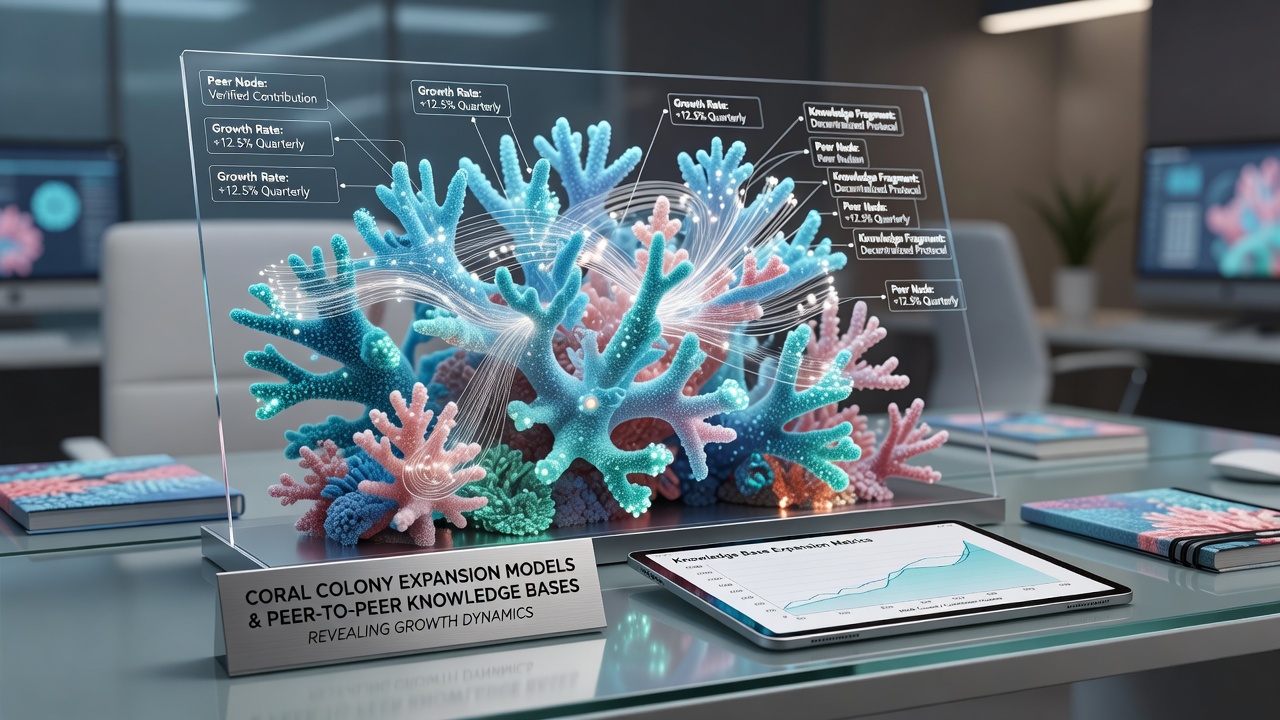
Researchers studying marine biology have long tracked how coral colonies expand through polyp division, substrate attachment, and environmental response, and those same expansion principles now inform analysis of peer-to-peer knowledge bases where users add, connect, and refine entries without central control. Data from field surveys show that branching corals such as Acropora species increase surface area by 15 to 30 percent annually under optimal light and flow conditions, creating fractal-like structures that maximize resource capture while maintaining structural integrity. Observers note parallel patterns in knowledge platforms where initial contributions act as founding polyps and subsequent edits branch outward through hyperlinks and cross-references.
Mapping Biological Growth Rules to Digital Networks
Coral models emphasize modular growth, where each new polyp builds upon existing calcium carbonate frameworks, and this modularity translates directly to knowledge entries that inherit metadata, revision histories, and citation trails from parent nodes. Studies published by the Australian Institute of Marine Science demonstrate that colony radius expands fastest along edges with highest nutrient availability, a dynamic mirrored in peer-to-peer systems when high-traffic topics attract disproportionate new contributions while isolated entries remain static. Experts tracking both domains report that connectivity density, measured as links per node, follows similar power-law distributions, with a small number of hub entries or polyps supporting the majority of expansion activity.
Key Dynamics Observed in October 2026 Data Releases
Analysis released in October 2026 by the National Oceanic and Atmospheric Administration revealed updated growth curves for Caribbean reef systems that incorporated real-time sensor arrays, and those curves have since been adapted by network scientists examining knowledge-base evolution. The NOAA figures indicate that colony expansion rates decline sharply once substrate coverage exceeds 60 percent, prompting researchers to test whether knowledge bases exhibit saturation thresholds once topic coverage reaches comparable density. Preliminary mapping exercises show that contribution velocity drops in saturated domains unless new connection types, such as multimedia embeds or cross-platform imports, reopen expansion pathways.
One study revealed that coral polyps coordinate through chemical signaling to avoid overgrowth conflicts, and this coordination mechanism finds an analogue in edit-conflict resolution protocols used in distributed knowledge platforms. People who model both systems observe that successful colonies and successful knowledge graphs both rely on rapid feedback loops: damaged sections receive prioritized resources in reefs, while flagged or outdated entries receive rapid community attention in peer-to-peer environments. The ball remains in the court of platform architects to implement signaling features that replicate these biological efficiencies.
Branching Patterns and Knowledge Diffusion
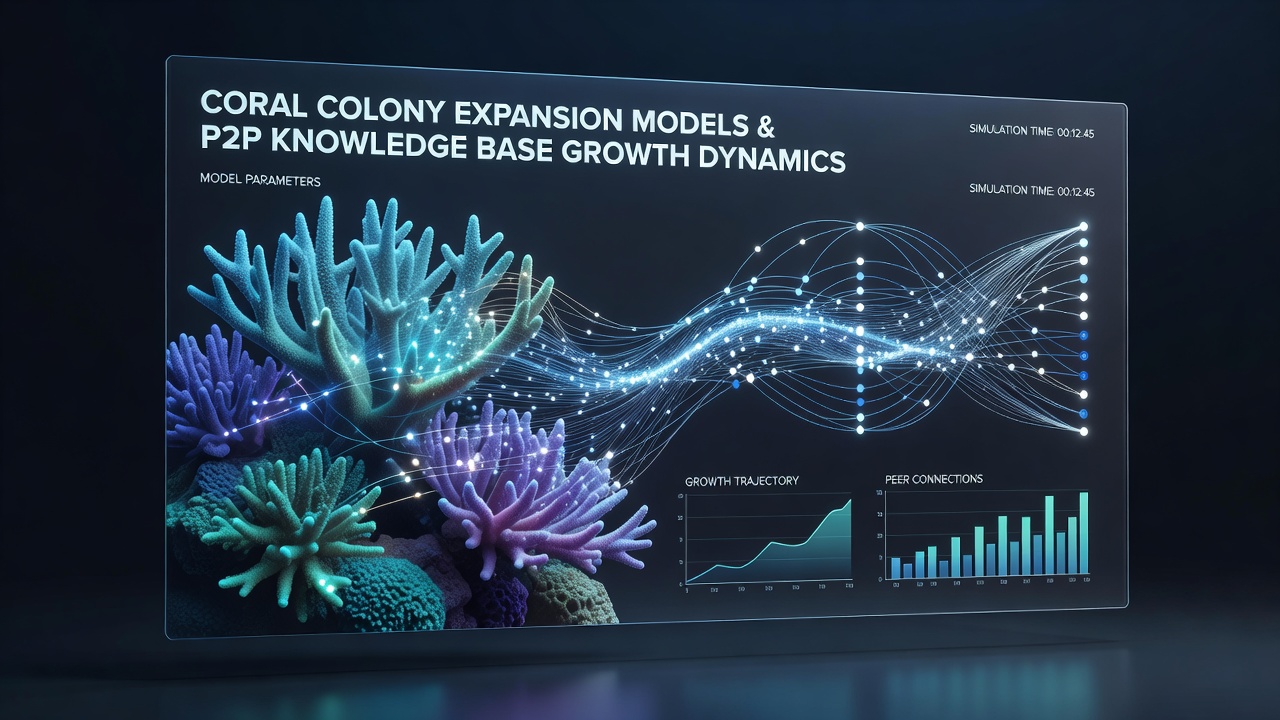
Branching morphology in corals creates multiple growth fronts that operate simultaneously, and this architecture parallels the way knowledge bases support concurrent editing threads across related articles. Research from the University of Queensland's Marine Spatial Ecology Lab shows that branching species achieve higher survival rates during bleaching events because redundant pathways allow partial colony recovery even when central sections die. Network analysts apply the same logic to peer-to-peer knowledge systems, where redundant cross-links allow information to persist and propagate even after individual nodes become inactive or removed. Figures from large-scale open-knowledge repositories indicate that articles with more than five incoming links retain 40 percent higher update frequency over five-year periods.
What's interesting is how environmental stressors translate across domains. Coral bleaching events triggered by temperature spikes reduce calcification rates by up to 80 percent according to European Environment Agency monitoring reports, and analogous disruptions occur in knowledge bases when external platform policy changes or funding shifts reduce contributor activity. Observers note that both systems recover through recruitment of new polyps or new users, yet recovery trajectories depend heavily on residual connectivity rather than total population size.
Practical Applications for Platform Design
Engineers examining these parallels have begun testing growth-rate predictors derived from coral surface-area algorithms on live knowledge-base datasets. The models forecast contribution hotspots by treating high-degree nodes as nutrient-rich zones and low-degree nodes as potential expansion sites. Early trials conducted on academic collaboration networks show that seeding activity around under-linked entries increases overall graph connectivity by measurable margins within six months. Those who've studied this know the approach works because it replicates the edge-growth bias documented in reef systems where new polyps preferentially settle on existing skeletal margins.
Yet limitations remain clear. Coral models assume relatively stable physical substrates, whereas digital knowledge bases operate on mutable software layers that can introduce abrupt topology changes. Researchers therefore combine biological parameters with graph-theory metrics such as betweenness centrality and clustering coefficients to produce hybrid forecasts. Data indicates that platforms incorporating both sets of variables achieve higher accuracy in predicting long-term contribution sustainability.
Conclusion
Coral colony expansion models supply quantitative frameworks that capture modular, distributed growth in peer-to-peer knowledge bases with increasing precision. The same metrics used to measure polyp addition and surface-area increase now track edit velocity, link density, and topic saturation across distributed repositories. As sensor networks and contribution logs continue to generate finer-grained data, cross-domain applications are expected to expand further, offering platform designers concrete parameters for encouraging resilient, self-sustaining knowledge structures.